
The main trends observed in recent years include:
- The large-scale integration of recycled plastics
- Energy optimization of extrusion machines
- Increasing production rates
- The digitalization of extrusion lines
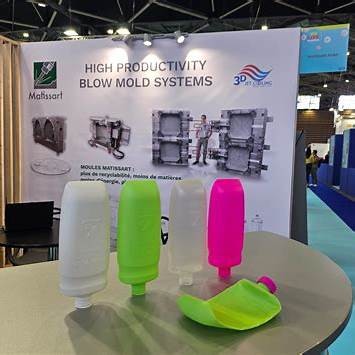
In the extrusion blow molding sector, international competition is intensifying. Manufacturers are investing heavily in high-performance equipment, high-speed production lines, and automated solutions. However, beyond the machinery itself, industrial performance ultimately relies on a key element: the mold.
High production rates only make sense if the tooling is capable of:
- Maintaining consistent thermal stability
- Withstanding wear over time
- Ensuring dimensional repeatability
- Reducing downtime and maintenance operations
At Matissart, we observe that increasing price competition should not come at the expense of technical robustness. An under-engineered mold can lead to:
- Increased scrap rates
- Quality variations
- Higher energy consumption
- Reduced tool lifespan
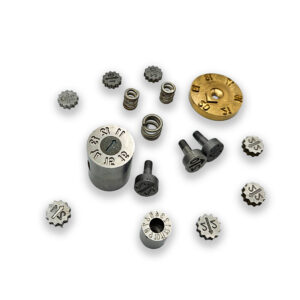
Conversely, a precisely engineered mold—integrating advanced thermal optimization and the right material selection (stainless steel, aluminum, or copper beryllium depending on the application)—becomes a direct lever for competitiveness.
For both European and international manufacturers, the challenge is clear:
combine performance, sustainabilitySustainabilityAn organisation’s ability to operate over the long term while balancing economic performance, environmental protection, social considerations and sound governance. Sustainability describes the long-term outcome sought; CSR refers to the management approach through which a company organises its contribution to that outcome., and precision to remain competitive.
At Matissart, we support this transformation through demanding mold engineering, focused on durability, thermal stability, and production efficiency.
In a rapidly evolving industrial world, technical excellence remains a key differentiator.