
Three Major Events Shaping the Future of Plastics Processing
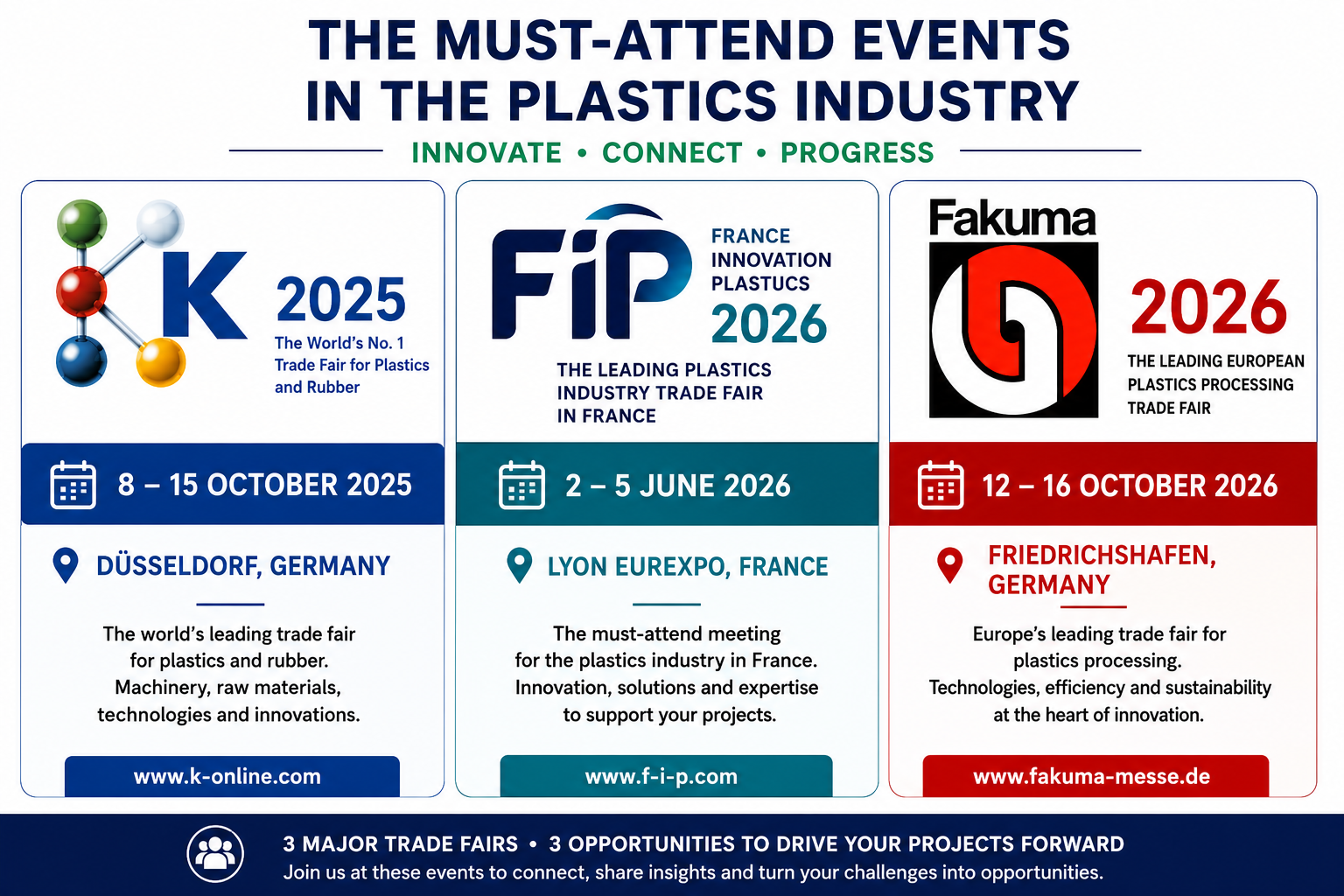
K, FIP and Fakuma remain Europe’s leading trade fairs for the plastics industry. Held on complementary schedules—K in Düsseldorf every three years, FIP in Lyon and Fakuma every two years in Friedrichshafen—they provide an excellent overview of the technologies shaping the future of plastics processing.
- K 2025 (8–15 October 2025) welcomed more than 3,000 exhibitors from 65 countries under the theme “The Power of Plastics: Green – Smart – Responsible.”
- FIP Lyon 2026, held from 2 to 5 June 2026, brought together more than 800 exhibitors, confirming its position as France’s leading plastics industry event.
- Fakuma 2026, taking place from 13 to 17 October 2026, will once again gather more than 1,600 exhibitors, showcasing the latest developments in plastics processing technologies.
The Main Technological Trends
Several key innovations emerged across these three major exhibitions:
- Artificial Intelligence applied to material development, production optimisation and sustainabilitySustainabilityAn organisation’s ability to operate over the long term while balancing economic performance, environmental protection, social considerations and sound governance. Sustainability describes the long-term outcome sought; CSR refers to the management approach through which a company organises its contribution to that outcome. reporting;
- Increased automation of production lines and quality control systems;
- Wider use of recycled polymers, including mechanically and chemically recycled materials;
- Improved energy efficiency throughout plastics processing;
- Metal additive manufacturing for tooling and industrial applications;
- Next-generation cooling technologies designed to improve productivity.
Artificial Intelligence Is Becoming a Standard Industrial Tool
Artificial Intelligence has become one of the fastest-growing themes across the plastics industry.Applications now extend from material formulation and process optimisation to predictive maintenance, sustainability reporting and quality inspection. Engineering departments are increasingly integrating AI into mould design, simulation and manufacturing processes to improve productivity while reducing development time.
Additive Manufacturing and Conformal Cooling Continue to Expand
Metal additive manufacturing is progressively moving beyond rapid prototyping towards industrial tooling production. This evolution enables increasingly sophisticated conformal cooling channels that cannot be achieved using conventional machining techniques. For extrusion blow mould manufacturers, these technologies offer significant opportunities to improve productivity, reduce cycle times and optimise thermal performance.
What Does This Mean for MATISSART?
These developments are reshaping customer expectations. Engineering teams must increasingly integrate:
- lightweight product design;
- recycled and bio-based polymers;
- improved recyclabilityRecyclabilityThe ability of a product or its constituent materials to be recovered, separated and treated so that they can be reintroduced into a new production cycle; recyclability does not guarantee that actual recycling will occur.;
- higher energy efficiencyEnergy efficiencyThe ability to deliver the same level of service or production while using less energy, particularly through improvements in equipment, processes or operational control.;
- digital engineering tools;
- smart manufacturing technologies.
For MATISSART, staying ahead of these technological developments remains essential to supporting customers with innovative, high-performance extrusion blow mould solutions.