
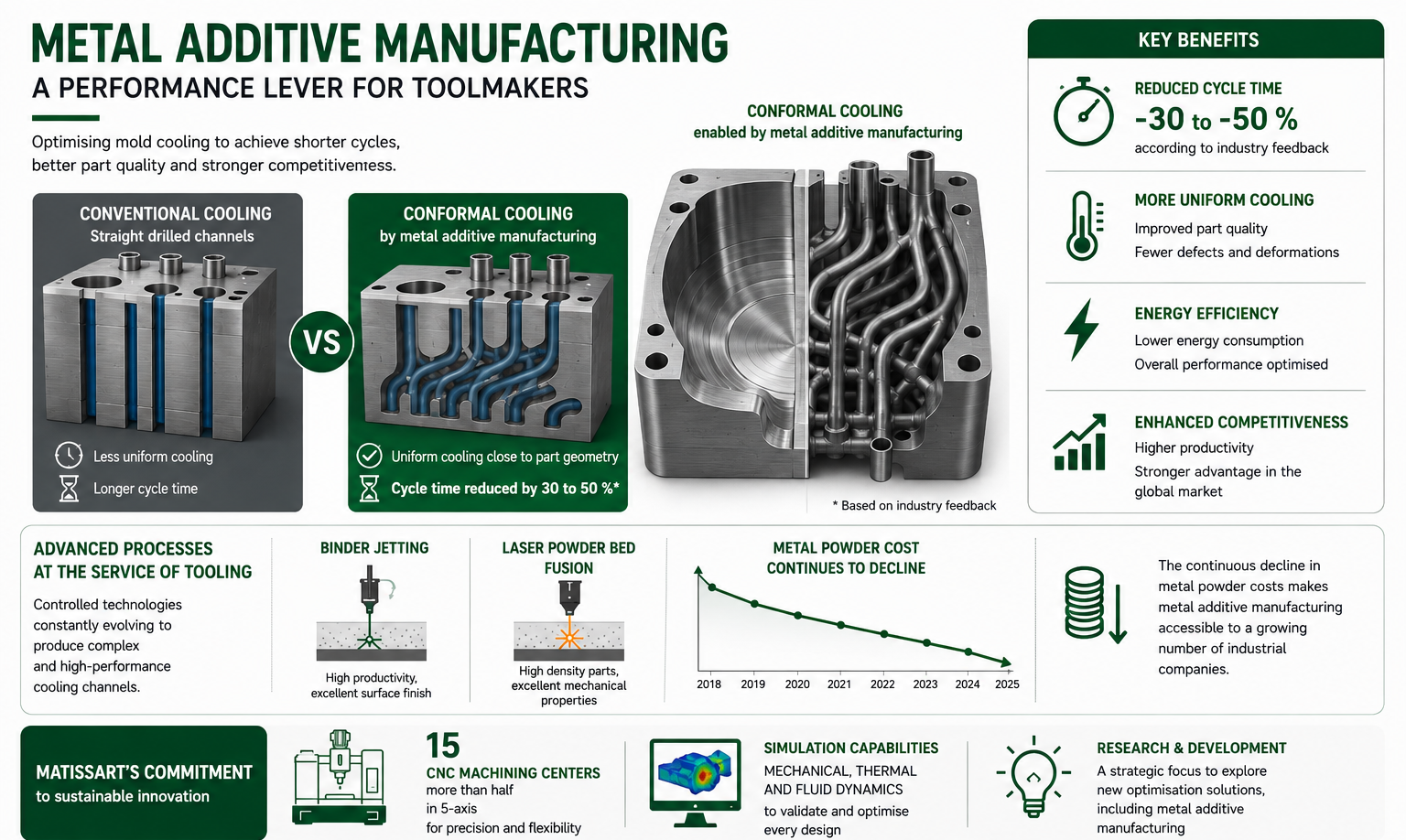
Metal additive manufacturing continues to open up new possibilities for tooling and precision engineering. Once largely associated with prototyping, metal 3D printing is increasingly being considered as a production technology for industrial tooling and complex components. One of its most promising applications is the production of conformal cooling channels. Unlike conventional straight drilled channels, conformal circuits can follow the geometry of the component more closely.
For mouldmakers, the potential benefits include:
- More homogeneous cooling;
- Improved thermal control;
- Greater design freedom;
- Potential reductions in cycle time;
- Optimisation of specific tooling components.
Technologies such as laser powder bed fusion and binder jetting are contributing to the development of new approaches to metal component production.
What does this mean for extrusion blow moulding?
The thermal performance of a mould directly influences the productivity of a blow-moulding line and the quality of the finished product. Improving cooling homogeneity and efficiency can therefore contribute to shorter cycles, better process control and reduced energy consumption per part produced.
For MATISSART, research and development is a strategic priority. Our machining capabilities, combined with mechanical, thermal and fluid simulation, enable us to continuously explore new optimisation opportunities, including those offered by metal additive manufacturing.
In a context where the European metallurgical and tooling industries are seeking new sources of competitiveness and resilience, these technologies could become an additional lever for differentiation and industrial performance.