
A new European framework set to transform packaging
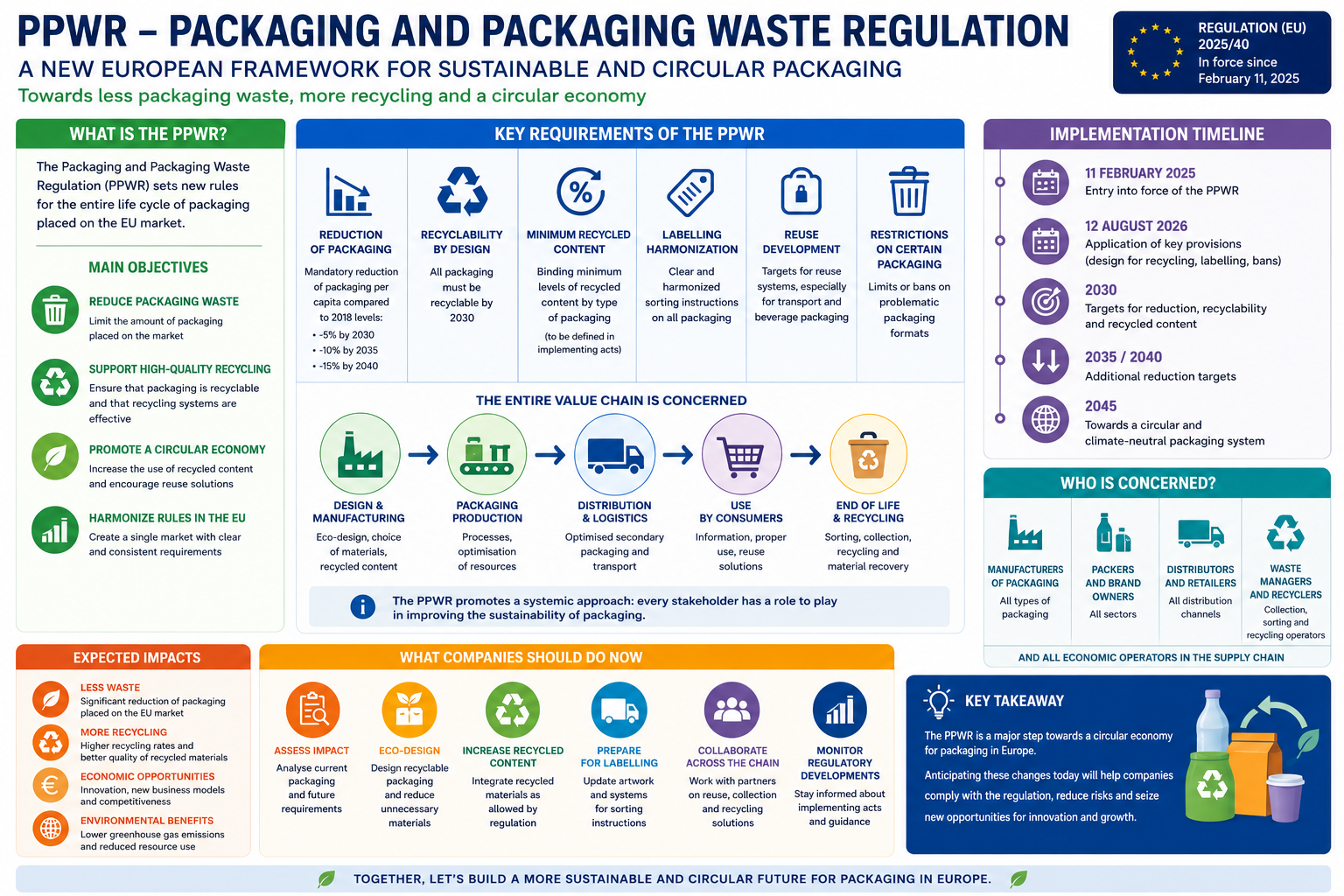
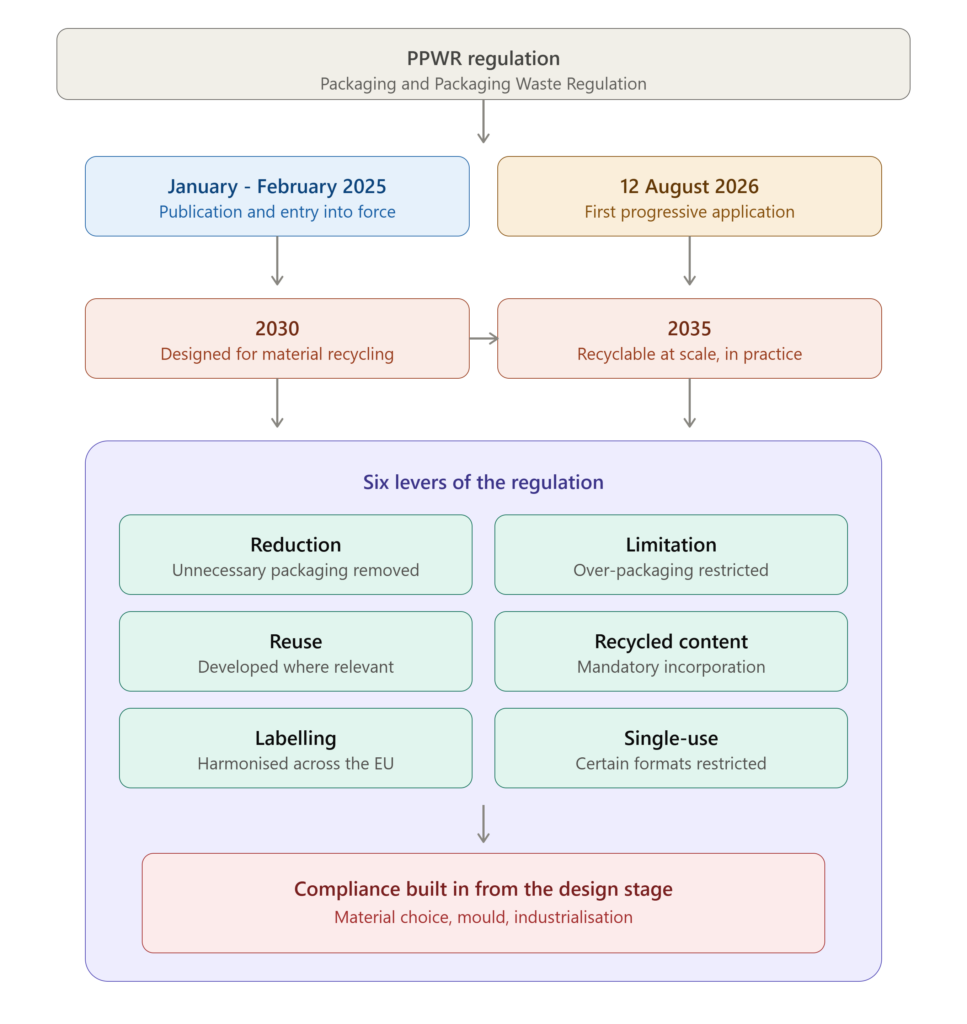
The European PPWR regulation (Packaging and Packaging Waste Regulation) marks a major shift in European packaging policy. Published in the Official Journal of the European Union in January 2025, it entered into force on 11 February 2025 and will be progressively applied from 12 August 2026. Its objective is clear: reduce packaging waste, improve recyclabilityRecyclabilityThe ability of a product or its constituent materials to be recovered, separated and treated so that they can be reintroduced into a new production cycle; recyclability does not guarantee that actual recycling will occur., and decrease the use of virgin raw materials.
Unlike the previous Packaging Directive, the PPWR is a regulation: it applies directly across all Member States, with the aim of harmonising the rules for European manufacturers.
Requirements set to transform packaging design
The PPWR provides, in particular, that all packaging placed on the European market must be recyclable in an economically viable way by 2030. From 2030, packaging will need to be designed for material recycling; from 2035, it will also need to be recyclable at scale, through collection, sorting and recycling channels that are genuinely available.
The regulation acts on several levers:
- Reducing unnecessary packaging;
- Limiting over-packaging;
- Developing reuseReuseUsing a product or piece of equipment again for the same purpose or a compatible purpose, without it having become waste and without major material transformation. where relevant;
- Incorporating recycled materials;
- Harmonising labelling;
- Restrictions on certain single-use packaging.
For packaging manufacturers, this means that compliance can no longer be addressed solely at the end of the production chain. It will need to be built in from the product design stage onward — from material selection through to industrialisation.
The challenge of recycled materials
One of the major impacts of the PPWR concerns the growing use of recycled materials. This requires better accounting for the sometimes more variable behaviour of recycled polymers:
- Different viscosity;
- More heterogeneous material quality;
- Variation in mechanical properties;
- Increased sensitivity to processing parameters;
- Different cooling behaviour.
These changes may require adjustments to mould design, cooling circuits, pinch points, tolerances, surface finishes, and trial and validation runs.
Key takeaway
The PPWR is not just a text about packaging waste. It is a regulation that will transform the entire packaging design and production chain.