



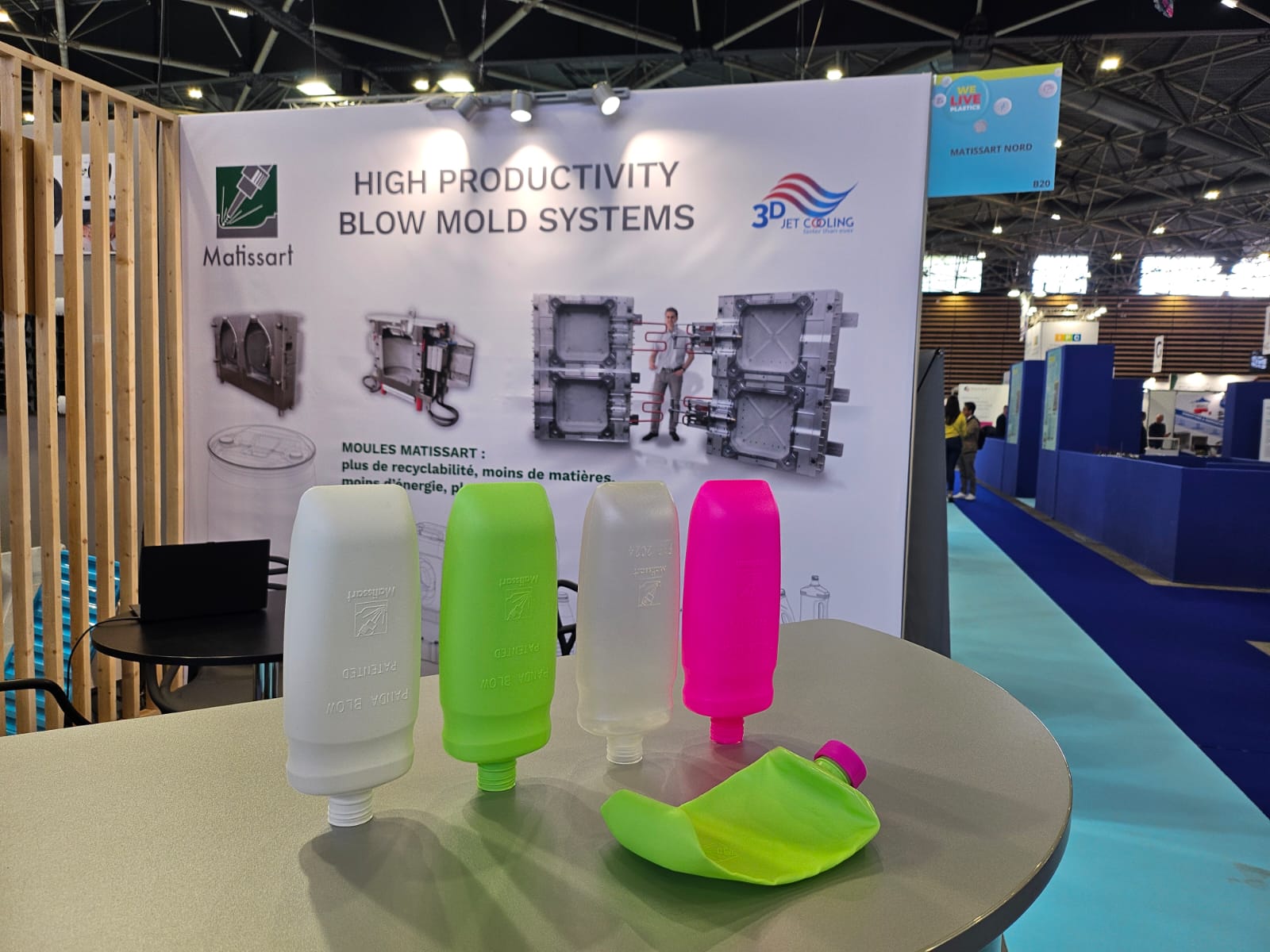
In early 2024, the French government unveiled its new national roadmap on recycling and circular economy, with ambitious targets:
- 100% recyclable plastics by 2025
- 50% recycled plastics in packaging by 2030
For extrusion-blow molding manufacturers, this shift represents not only a change of paradigm but also a strategic opportunity.
1. Market Shift: Recycled Content Becomes a Key Commercial Criterion
Brands and retailers will now be required to demonstrate:
- the percentage of recycled content used,
- the true recyclability of their packaging,
- the traceability of their recycling streams.
This accelerates demand for:
- high-quality recycled HDPE (rHDPE),
- post-consumer rPP,
- mono-material solutions.
➡ PMIs like MATISSART, able to quickly adapt tooling and formulations, will be major winners in this transition.
2. Extrusion-Blow Molding: A Core Process in the Transition
French blow-molding manufacturers are being asked to:
- optimize weight reduction and rigidity,
- design mono-material packaging,
- develop geometries that improve recyclability,
- integrate increasing levels of PCR while maintaining mechanical performance.
Thanks to innovations in:
- high-precision dies,
- improved cooling systems,
- optimized molds (jet cooling, lightweight structures),
the sector is positioning itself as a major player in industrial decarbonization.
Extrusion-blow SMEs like MATISSART have a key advantage: ➡ reactivity + field expertise + strong innovation capability.
Conclusion
In an increasingly demanding regulatory environment, companies like MATISSART that anticipate market evolution—lightweighting, PCR integration, energy optimization—will significantly strengthen their competitiveness.
Extrusion-blow molding is emerging more than ever as a future-proof, sustainable process driving France’s ecological transition.