
Measuring to take more effective action
To give this approach a structured basis, Matissart carried out its greenhouse gas inventory through the Diag Décarbon’Action programme, supported by ADEME, Bpifrance and the Association pour la Transition Bas Carbone.
This initial assessment identifies the main sources of emissions, helps prioritise actions, and establishes a baseline against which to track progress over time.
Our approach is based on three principles:
Understand our carbon footprintCarbon footprintThe total quantity of greenhouse gas emissions directly and indirectly associated with an activity, organisation, product or service, generally expressed in CO₂e. and identify the main sources of emissions.
Prioritise action on emission sources that the company and its value chainValue chainAll activities, stakeholders and flows upstream, within and downstream of a company, from raw-material purchasing through product use and end of life. can influence.
Monitor our results, improve the quality of our data, and progressively incorporate decarbonisationDecarbonisationThe progressive reduction of greenhouse gas emissions associated with an activity, product, process or value chain. into our industrial decision-making.
Methodology and calculation tools
The inventory was prepared using the Bilan Carbone®Bilan Carbone®A greenhouse gas accounting methodology used to estimate an organisation’s direct and indirect emissions and identify its main emission sources. methodology, developed and implemented by the Association pour la Transition Bas Carbone (ABC). The calculations use reference emission factors from ADEME’s Base Empreinte®Base Empreinte®ADEME’s reference database containing, among other data, emission factors used to quantify environmental impacts and greenhouse gas emissions., ensuring reliable results that meet the regulatory reporting format and are directly comparable with national reference frameworks.
Methodology and calculation tools used:

Key emission factors used
The main emission factors used also enable results to be presented in the regulatory reporting format and communicated through Base Empreinte:

Assessment boundary
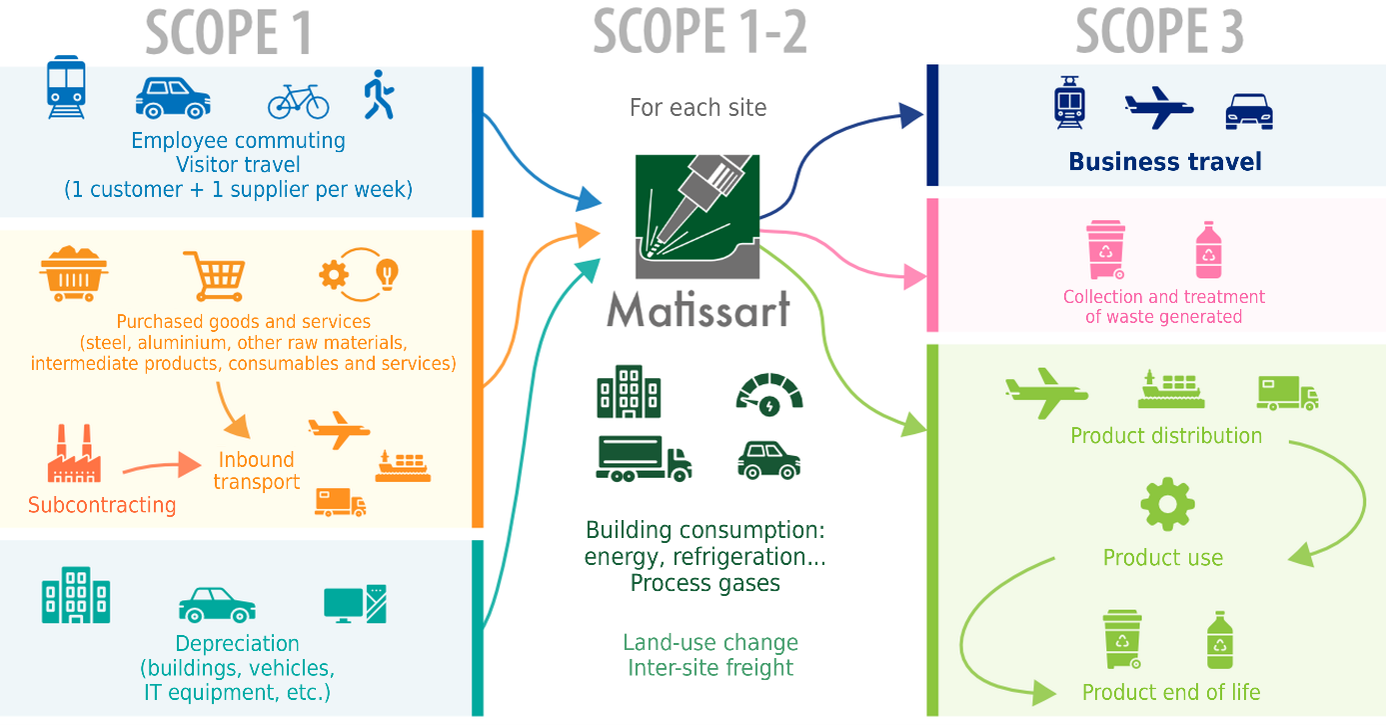
The assessment covers all of the company’s direct and indirect activities in accordance with the Bilan Carbone® methodology:
- Scope 1Scope 1The category covering direct greenhouse gas emissions from sources owned or controlled by the company.: direct emissionsDirect emissionsGreenhouse gas emissions from sources owned or directly controlled by the company, generally classified under Scope 1.;
- Scope 2Scope 2The category covering indirect emissions associated with the generation of purchased energy consumed by the company, particularly electricity, heat or steam.: energy consumption;
- Scope 3Scope 3The category covering other indirect emissions across the value chain, such as purchased goods and services, transport, business travel, subcontracting, capital goods or product end of life.: procurement, transport, travel, subcontracting, capital goods and other indirect emissionsIndirect emissionsGreenhouse gas emissions linked to the company’s activities but originating from sources it does not own or directly control, including purchased energy, procurement, transport or subcontracting..
t CO2e
Matissart Nord’s 2022 GHG inventory: 1,263 tCO₂etCO₂eTonne of carbon dioxide equivalent, the unit used to express and aggregate emissions of different greenhouse gases according to their global warming potential.
Equivalent to the annual emissions of 126 French people, or 380 flights around the Earth.
Emissions breakdown
kg CO2e per EUR 1,000 of turnover
tCO₂e per employee
Key indicators
Baseline results
| Indicator | Result |
|---|---|
| Baseline yearBaseline yearThe year selected as the starting point for measuring and comparing the evolution of an indicator over time, for example greenhouse gas emissions. | 2022 |
| Total emissions | 1 263 tCO₂e |
| Scope 1 | 85 tCO₂e |
| Scope 2 | 22 tCO₂e |
| Scope 3 | 1 156 tCO₂e |
| Uncertainty level | 13 % |
This finding directly informs our strategy: reducing our footprint requires us to improve our own performance and to work with our entire value chain.