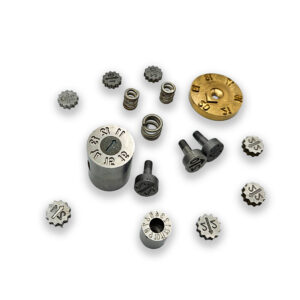

A typical mould, material by material*
The following table presents average proportions that depend on mould size, the number of cavities, inserts, cooling circuits, plates, fasteners and accessories. Extrusion blow moulds consist predominantly of metals. Depending on their design, metallic materials generally account for more than 95% of their mass, mainly aluminium and steel, with copper alloys used in certain technically demanding areas.
| Mould characteristic | Indicative metal content |
|---|---|
| Main material | Steel / Aluminium |
| Average metal content by mass | 95 % |
| Basic aluminium / steel mould | 95 à 99 % |
| Mould with CuBe / copper alloy inserts | 95 à 99 % |
| Mould with numerous ancillary accessories | 90 à 98 % |
| Mould only, excluding hoses and consumables | Often > 95 % |
* This is an average figure that depends on the mould’s size, number of cavities, inserts, cooling circuits, plates, fasteners and accessories. Extrusion blow moulds are made predominantly of metals. Depending on their design, they generally comprise more than 95% metallic materials by mass, mainly aluminium, steel and, in certain functional areas, copper alloys..
Before recycling: extend the mould’s service life
| Option | At MATISSART |
|---|---|
| RepairabilityRepairabilityThe ability of a product or piece of equipment to be repaired so that it recovers all or part of its function and its useful life can be extended. | Yes – encouraged |
| Maintenance | Yes – encouraged |
| RefurbishmentRefurbishmentAn operation aimed at restoring, improving or adapting existing equipment in order to extend its useful life and, where relevant, avoid premature replacement. | Yes – encouraged |
| Adaptation | Yes – encouraged |
Extending a mould’s service life is not enough: it must also be possible for its constituent materials to be recycled in practice at the end of its life.
At end of life: recover the metals
| Question | Answer |
|---|---|
| Are the main metals used in the mould recyclable? | Yes |
| Are metal recovery routes available? | Yes |
| What needs to be done at end of life? | Identify the materials Disassemble and separate components where necessary Direct the metals to appropriate recovery facilities |
Preserving the materials after preserving the equipment
The circular economyCircular economyA model aimed at keeping the value of products, equipment, materials and resources in use for as long as possible through durability, maintenance, repair, reuse and recycling. and recyclabilityRecyclabilityThe ability of a product or its constituent materials to be recovered, separated and treated so that they can be reintroduced into a new production cycle; recyclability does not guarantee that actual recycling will occur. therefore apply at two distinct but complementary stages in a mould’s life:
stages in a mould’s life:
CIRCULAR ECONOMY
→ Extend the equipment’s service life: maintain, repair, refurbish, adapt and reuseReuseUsing a product or piece of equipment again for the same purpose or a compatible purpose, without it having become waste and without major material transformation..
RECYCLABILITY
→ Once the equipment can no longer be used: collect and separate its constituent materials, then recover their value.
When a mould has genuinely reached the end of its life, the aim is no longer to preserve its function, but to preserve the value of its materials.